Oct 31, 2026Industry Knowledge
Inside a Plush Dog Toy: 8 Construction Details That Decide Quality
Two plush toys can look identical yet behave completely differently in a dog's mouth. These eight construction details decide which one survives.
Stand in front of a plush toy wall and everything looks broadly the same: a soft animal, a stitched face, a hang tag. Then the toys go home with customers, and within a week the differences appear. One keeps its shape and comes back for a second purchase. Another loses a limb, sheds its face, or turns into a pile of stuffing on the living-room floor. The gap between those two outcomes is not design - it is construction. These eight details are the ones that decide which of your SKUs earns a repurchase, and every one of them can be checked before you place an order.
1. The Fabric: Pile, Weave and What It Says About Wear
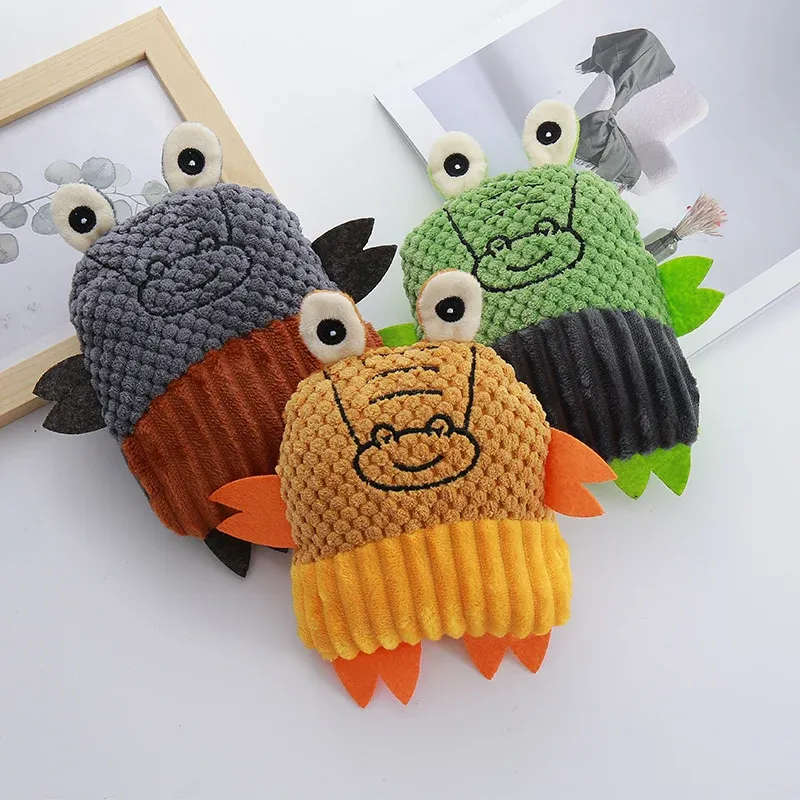
Fabric is the first and most visible variable. Short-pile plush with a tight knit resists snagging and holds its shape; long, loose pile feels luxurious on the shelf and mats into clumps after a few days of chewing. Our range deliberately spans several textures because they sell to different customers: crystal super-soft plush for the classic cuddle toy, corn-grain knit for the textured look and slightly firmer hand, rabbit-fur plush for a premium feel, mop plush for the shaggy character toys, bean-dot plush for tactile bubble-surface designs, and corduroy and polar fleece where the look is the point. Run your thumb against the pile, then against the grain and back: fibers that lift easily or shed onto your hand will look worn within a week.
2. The Pattern: Proportion Is a Quality Signal
Look at the silhouette rather than the face. A well-drafted pattern gives the toy a balanced body with enough room for the filling to sit evenly - legs that do not twist, a head that does not droop, a tail attached where the stress actually lands. A cheap pattern shows up as a lopsided body, a neck that is too narrow for the head, or limbs stitched on at an angle that pulls the seam when the dog shakes it. If a design is offered as a size run - a duck in S, M and L, for example - check that the proportions scale properly rather than the small size being a shrunken photocopy with a head too large for its body.
3. Cutting: the Invisible Half-Millimeter
You cannot see the cutting table in a finished toy, but you can see its mistakes. Inconsistent cutting shows up as a seam that wanders away from the edge, a limb that is visibly narrower on one side, or a pattern that does not line up across a seam. Turn the toy inside out at an opening if you can reach one: an even seam allowance all the way round means the fabric was cut accurately and the operator had enough material to work with. A ragged, pinched or uneven allowance is the single most common cause of a seam that fails months later.
4. Seams at Stress Points
Most plush toy failures are not a tear in the middle of a panel - they are a seam letting go at a stress point. Those points are predictable: where the limbs meet the body, where the tail attaches, around the neck, and along the belly if the toy is a kicker. Good construction double-stitches or back-stitches those joints and often adds a reinforcing stitch line just inside the seam. Grip a limb and give it a firm, steady pull - not a yank - and watch the seam. If the stitches pull open or the surrounding fabric puckers permanently, that joint will not survive real play.
5. The Face: Embroidered, Printed or Glued
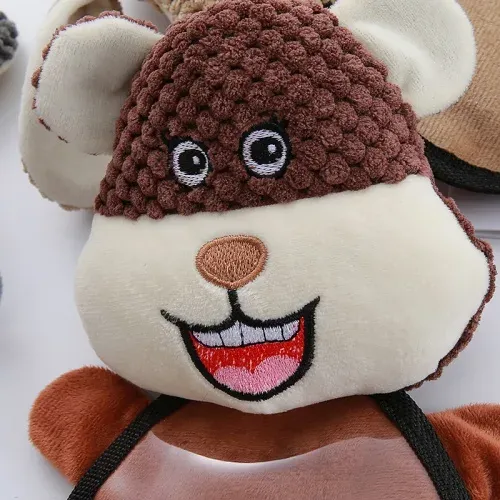
This is the detail with the clearest quality and safety signal. Embroidered faces are stitched into the fabric and cannot come loose. Printed details sit in the fabric surface and wear gradually. Glued-on eyes, noses and small hard accessories are the ones to scrutinize - they are the first parts to detach, and on a toy sized for a small dog a detached hard part is a choking risk. Press each face element with a thumbnail: if it lifts at the edge, it is glued. For small-breed and puppy products, embroidered or printed faces are the safer specification.
6. Stuffing: Density and Fiber
Squeeze the toy in three places - head, belly, and the end of a limb - and compare. Even resistance across all three means the filling was packed consistently; a hard head with a collapsed belly means it was stuffed by eye. Our plush toys use polyester fiber filling, which holds loft well and recovers its shape after compression, and the difference between a good and a mediocre toy is usually how much of it went in and how evenly. Under-stuffed toys feel deflated and crease permanently; over-stuffed toys strain their seams. A well-built toy springs back into shape when you let go.
7. Sound Elements: Squeakers and Crinkle
A squeaker is a small hard component sitting inside a soft product, so how it is installed matters as much as whether it is there. Feel for it: it should sit in the body cavity, wrapped in filling, not directly under a thin single layer of fabric where a determined chewer can reach it. Crinkle paper works the opposite way - it is a layer that has to be sewn into the panel so it stays distributed rather than bunching into one corner. In our range, crinkle appears as a specified feature on particular designs (the crinkle bug range, corn, candy, butterfly, long-body animals and the breakfast set) rather than being assumed across a whole category. Check that the sound is where the design says it is.
8. Packing: What the Tag and Carton Tell You
Packing is construction you can read from the outside. A backer card keeps a small toy presentable on a peg and protects the face during shipping; a hang tag suits larger floor items; a folded card with an OPP bag protects natural-material and textured surfaces; a colour box signals a gift purchase. Our plush programs ship on backer cards with 12 pieces per inner box, or on hang tags, folded cards and colour boxes depending on the design - and the inner-box count is what actually determines how fast your shelf can be restocked without over-ordering. Check that the tag carries size and care information in your market's language, and that the carton count matches what the quotation says.
The Five-Minute Sample Test
When a sample arrives, run the same five checks every time and you will catch most problems before they reach a container. One: the tug test. Firm, steady pull on each limb and the tail - watch the seam, not the fabric. Two: the squeeze test. Head, belly, limb end - compare resistance and check the toy springs back. Three: the thumbnail test. Press every face element and any attached accessory to see whether it lifts. Four: the inside-out check. Where you can reach an opening, look at the seam allowance and the stitch quality. Five: the shake test. Shake the toy firmly next to your ear - a squeaker or crinkle layer that shifts audibly is not properly located. Five minutes per sample, five checks, and you have a much more reliable picture than any photograph can give you.
What This Means for a Buy Sheet
These details do not all need to be premium - they need to match the specification tier and the customer. A supermarket impulse line can live with printed faces and lighter stuffing; a specialty pet store selling to dedicated owners cannot. The practical approach is to specify the two or three details that matter most for each SKU rather than demanding everything at once, and to write them into your purchase order so they are checkable at inspection: fabric type, face construction, seam reinforcement at stress points, filling specification, sound feature placement, and packing format with inner-box count. A toy whose specification is written down is a toy you can reorder with confidence.
Frequently Asked Questions
How can I tell a well-made plush toy from a photo?
Honestly, only partly. Photos show fabric texture, face construction and proportions reasonably well, but seams, stuffing density and squeaker placement need a physical sample. That is why we recommend confirming samples before every first order and every customization.
Which construction detail fails first in real use?
In our experience with plush returns, the seam at a limb or tail joint goes before the fabric does. That is why stress-point reinforcement matters more than pile length when you are comparing two similar designs.
Can these details be specified for an OEM order?
Yes. Fabric type, face construction, filling specification, sound features and packing format can all be specified on an existing design, which keeps tooling costs down. Send us the sample or reference and the details you want changed, and our sales team will quote the customized version within 24 hours.
Browse the Dog Toys category to see the plush range with sizes and packing, or contact us to request samples and discuss specifications.